OpenAI Updates GPT-5.6 Sol and Gives Free ChatGPT Users Unlimited Text Chats
By Suad Seferi ·
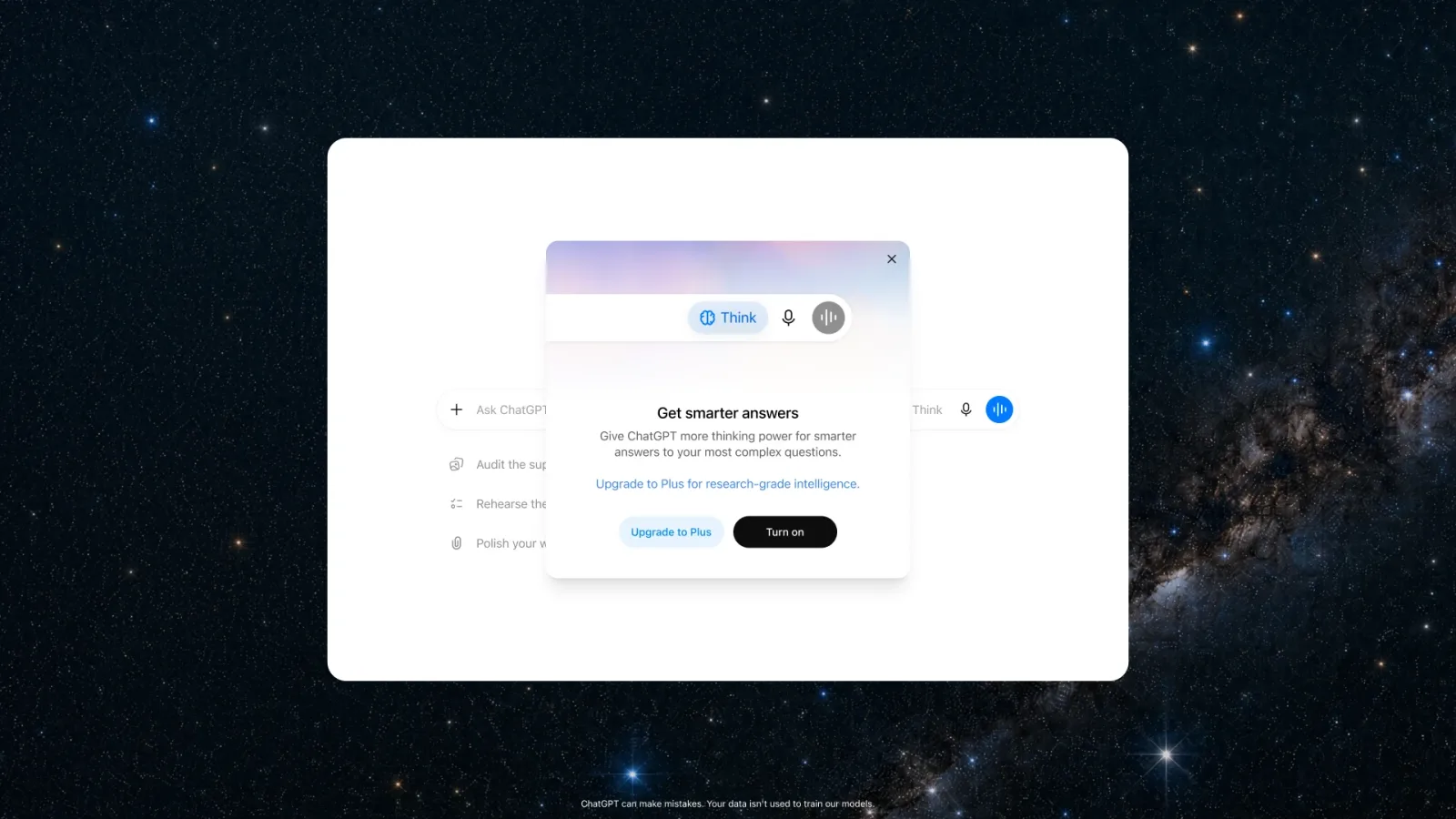
OpenAI is changing how its latest ChatGPT models respond to everyday questions, with an update designed to make answers more focused, factually reliable and consistent. The company announced on August 6 that it is updating GPT-5.6 Sol for ChatGPT Plus and Pro subscribers. Free and Go users, meanwhile, will receive GPT-5.6 Luna as their default model, followed by unlimited text conversations and a new option for requesting deeper reasoning. Rather than presenting the release as another dramatic leap in artificial intelligence, OpenAI is concentrating on problems that ordinary users notice during daily conversations: answers that take too long to reach the point, repeat information, rely on unnecessary formatting or include details that sound confident but are not correct. The updated GPT-5.6 Sol is intended to provide a direct answer first and then add only the context the question requires. A simple request should produce a concise response, while more complex work involving research, writing, planning or coding can still receive a fuller explanation. OpenAI wants ChatGPT to answer the real question first One of the clearest changes is a stronger emphasis on relevance. OpenAI says GPT-5.6 Sol has been tuned to avoid excessive detail and tighter formatting when a long response would not help. It should also correct a user when simple agreement would be misleading. That may sound like a small adjustment, but it addresses a common weakness in consumer AI products. A model can provide technically relevant information while still failing to understand what the person actually needs. Someone asking whether they should cycle home in the rain, for example, is usually looking for a practical decision—not a miniature weather report. OpenAI used a similar example in its announcement to show how GPT-5.6 Sol places the recommendation before the surrounding details. This focus on usefulness suggests that competition between AI companies is moving beyond raw benchmark results. As leading models become more capable, their value will increasingly depend on whether people can trust them to communicate clearly and exercise reasonable judgment. GPT-5.6 Sol is designed to make fewer factual mistakes OpenAI is also claiming a noticeable improvement in factual reliability, particularly for questions involving dates, figures, regulations, assumptions and source material. In an internal evaluation covering financial, medical and legal prompts, the company said responses containing at least one factual error were approximately 62% less common with GPT-5.6 Luna and 68% less common with GPT-5.6 Sol when compared with GPT-5.5 Instant. The results are encouraging, although they should not be interpreted as proof that hallucinations have disappeared. The evaluation was conducted internally, and OpenAI’s announcement does not provide enough detail for the public to independently reproduce every part of the testing process. Users should therefore continue checking important medical, legal and financial claims against authoritative sources. A lower error rate is meaningful, but it is not the same as guaranteed accuracy. For OpenAI, however, making factual reliability a central part of the release is significant. People are increasingly using ChatGPT for work that can have real consequences, and a fluent but incorrect answer may be more dangerous than an answer that openly acknowledges uncertainty. Plus and Pro users receive a reasoning slider ChatGPT Plus and Pro subscribers will also receive a new control that lets them choose how much reasoning the model should apply before answering. The slider will be available across ChatGPT’s web, mobile and desktop applications. Users can keep the setting low for straightforward questions or increase it for research, planning, writing, programming and decisions that require more careful analysis. OpenAI is also bringing its Instant and deeper-thinking experiences closer together. The same GPT-5.6 Sol model will power both modes for paying users, which should make the assistant’s tone and behaviour feel more consistent. Until now, switching into a stronger reasoning mode could sometimes feel like moving to a different assistant. The updated experience is meant to feel more like the same model taking additional time to think. For professionals, this could be more practical than manually choosing among several similarly named models. A small coding question may need speed, while an architecture review or business decision may justify slower and more detailed reasoning. Free ChatGPT users get the most important access change The biggest practical development may be the expansion of access for people using ChatGPT without a paid subscription. GPT-5.6 Luna will become the default model for Free and Go users during the week of the announcement. From the following week, OpenAI says those users will receive unlimited text conversations, subject to safeguards intended to prevent abuse. Free users will also gain a new Think button. When a question is more difficult, they can use it to give GPT-5.6 Luna additional time to reason before producing an answer. The unlimited access applies specifically to text conversations. Restrictions will remain for file uploads, image generation and other ChatGPT tools. Even with those limits, the change could make the free service considerably more useful. People who rely on ChatGPT for studying, translation, writing, programming or small-business tasks will be able to maintain longer conversations without repeatedly reaching a text-message cap. This may be particularly relevant in countries where the cost of an AI subscription represents a larger part of an average monthly income. Across the Balkans, students, freelancers, educators and small companies often depend on free digital services rather than paid professional plans. The update does not change Codex OpenAI has clarified that this version of GPT-5.6 Sol is optimised for everyday conversations inside…