Microsoft Data Shows AI Use Rising Across the Balkans
By Suad Seferi ·
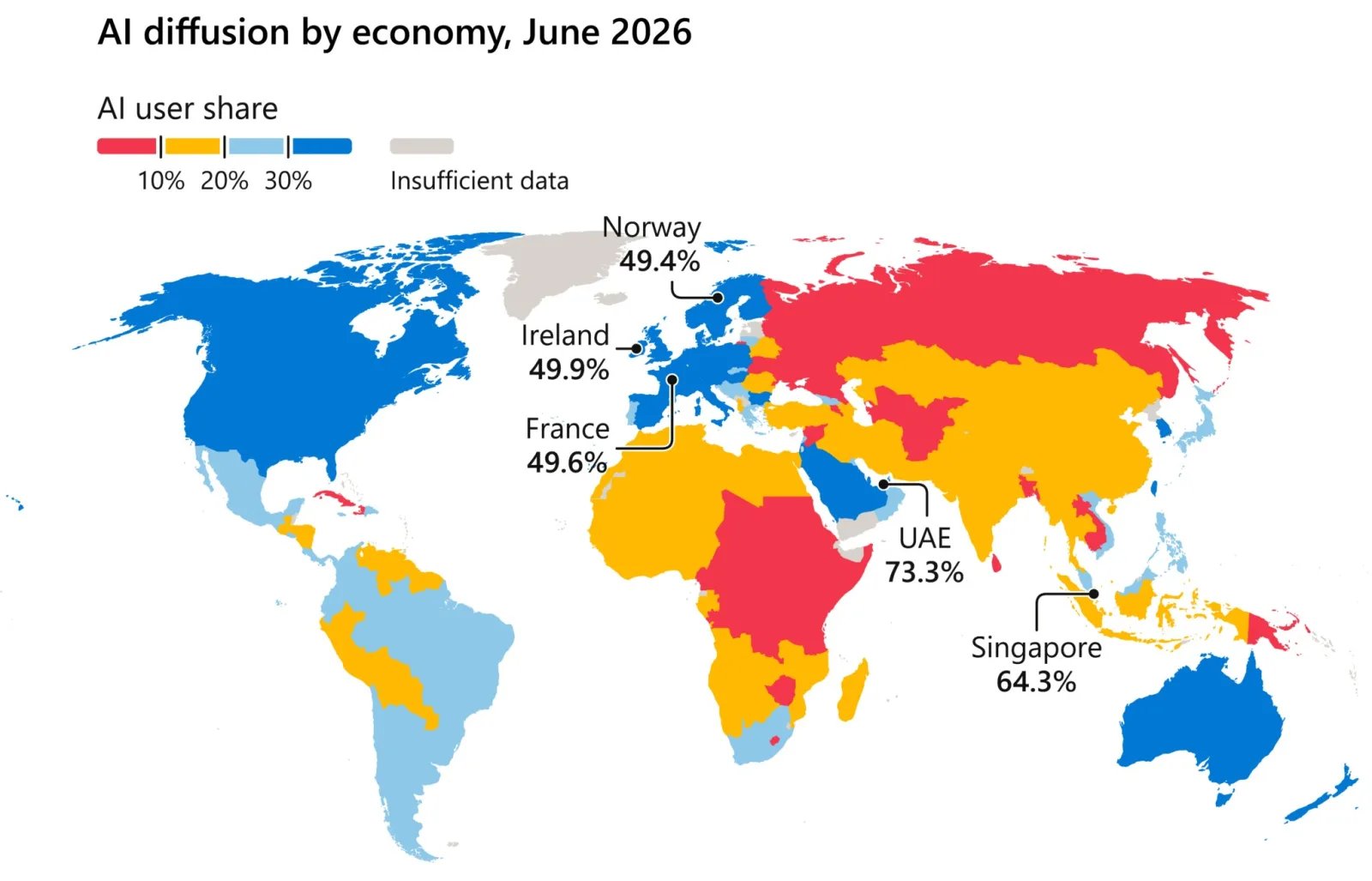
Generative AI use is continuing to rise across much of the Balkans, but Microsoft’s latest global data shows considerable differences between countries in the region. Microsoft’s AI Economy Institute reported this week that 18.8% of the world’s working-age population used a generative AI product during the second quarter of 2026, up from 17.8% in the first quarter. The study covers 147 economies and measures the share of people aged 15 to 64 who have used generative AI. Several Balkan countries remain above the global average. Croatia reached an AI user share of 27.2% in the second quarter, up from 26.1% in Q1. Serbia increased from 24.1% to 25.3%, while Bosnia and Herzegovina rose from 22.1% to 23.2%. Albania moved from 18.5% to 19.2%, putting it slightly above the global rate. Greece reached 21.5%. There are larger differences around the region when neighbouring EU countries are included. Bulgaria recorded 30.7% and Slovenia 30.1%, while Romania remained below the global average at 18%. Microsoft’s published Q2 dataset does not provide figures for North Macedonia, Kosovo or Montenegro. AI use is growing, but not at the same speed The regional figures follow the broader global trend. Microsoft recorded increases across almost every economy it measured during the quarter. The United Arab Emirates remained the global leader at 73.3%, followed by Singapore at 64.3%. Ireland reached 49.9%, making it the highest-ranked European economy in the latest data. But the report also points to a widening divide in access and use. Generative AI usage among the working-age population in what Microsoft classifies as the Global North reached 28.8%, compared with 16.2% in the Global South. The gap increased from 12.1 percentage points in the first quarter to 12.6 points in the second. Microsoft links part of that difference to access to electricity, internet connectivity, computing infrastructure and digital skills. For the Balkans, the figures suggest that having access to the same AI models does not necessarily produce the same level of adoption. Croatia, Serbia and Bosnia and Herzegovina are all above the global average, while Albania is only slightly above it and Romania slightly below. Slovenia and Bulgaria have already crossed the 30% level. What Microsoft is actually measuring The numbers should not be interpreted as a ranking of how advanced a country is in artificial intelligence. Microsoft defines its AI diffusion measure as the proportion of the working-age population that has used a generative AI product during the reporting period. The estimates are based on aggregated and anonymised Microsoft telemetry and are adjusted for factors including operating-system and device market share, internet penetration and population. Microsoft itself notes that no single metric can fully capture AI adoption or its economic impact. The indicator therefore tells us primarily how widely generative AI is being used, rather than whether companies are successfully integrating AI into their operations, whether governments are deploying it effectively or whether countries are developing their own AI infrastructure. That distinction is particularly important for the Western Balkans. A country can have high consumer use of ChatGPT, Copilot or similar tools while still having limited AI adoption inside businesses, public institutions and critical sectors. Education is becoming an important entry point Microsoft also found a difference in how AI is being used. Among the Copilot interactions included in its analysis, learning and skills development accounted for a larger share of activity in the Global South than in the global mix. Schoolwork and academic support were also disproportionately common. That finding could be relevant to countries across the Western Balkans, where education, workforce skills and access to practical AI training are increasingly becoming part of national and regional discussions about AI readiness. Microsoft also points to the increasing use of open-weight AI models as another factor that could broaden access. Such models can reduce costs and make it easier to adapt systems to smaller languages and local requirements, although infrastructure and skills remain constraints. The next question for the region is therefore no longer simply whether people are using AI. The more important measure will be whether that growing individual use translates into better skills, more productive organisations, stronger local-language tools and practical adoption inside businesses and public institutions. Microsoft’s figures show that AI use is spreading across the Balkans. They also show that the region is not moving at one speed.