OpenAI’s GPT-5.6 Sol Arrives
By Suad Seferi ·
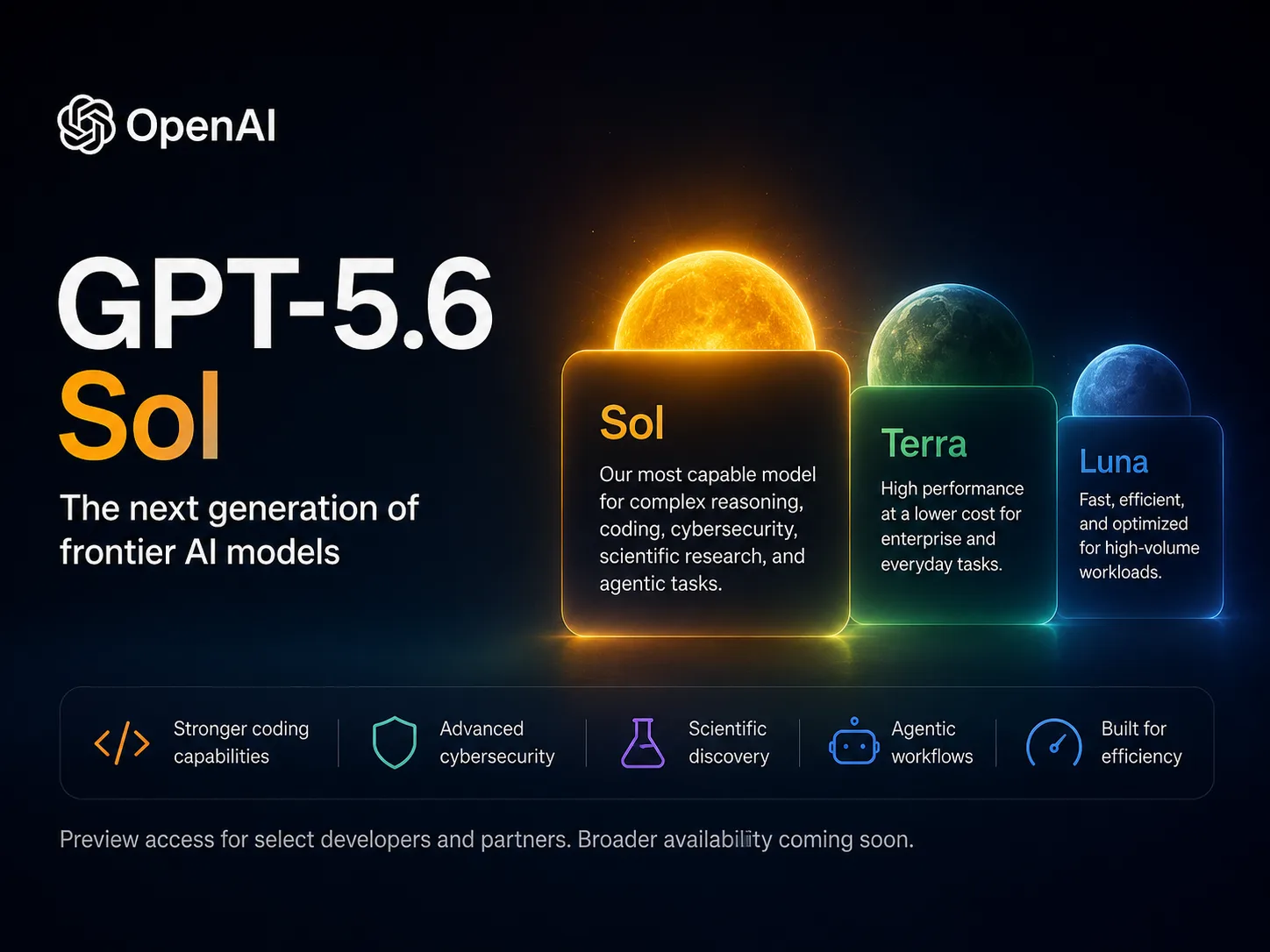
OpenAI has unveiled GPT-5.6 Sol, its newest flagship artificial intelligence model, alongside two additional models—Terra and Luna—in a limited preview for selected developers and organizations. The new model family represents OpenAI's latest step toward AI systems capable of handling complex, long-running tasks with greater accuracy, efficiency, and reliability. Rather than releasing a single model designed for every use case, OpenAI is introducing a three-tier lineup tailored to different workloads. The company says the approach gives developers and businesses greater flexibility by allowing them to choose the right balance between capability, speed, and cost. Three Models, Three Different Roles The new GPT-5.6 family consists of: GPT-5.6 Sol, OpenAI's most capable model, built for advanced reasoning, software engineering, cybersecurity, scientific research, and complex agentic workflows. GPT-5.6 Terra, designed to deliver strong performance while reducing operational costs for enterprise applications. GPT-5.6 Luna, the fastest and most affordable model in the lineup, optimized for large-scale deployments where speed and efficiency are the primary priorities. According to OpenAI, the three-model strategy reflects the growing diversity of AI workloads. Instead of relying on a single model for every task, organizations can now select a model that better matches their technical and financial requirements. A Stronger Focus on Agentic AI One of the biggest themes of GPT-5.6 is the continued evolution of agentic AI. Unlike traditional AI assistants that respond to individual prompts, agentic systems are designed to complete extended workflows involving planning, coding, research, tool usage, and multi-step reasoning while maintaining context over longer periods. OpenAI says GPT-5.6 Sol demonstrates significant improvements in software development, cybersecurity analysis, scientific reasoning, and autonomous task execution, making it suitable for developers and organizations building increasingly sophisticated AI-powered applications. Built With Extensive Safety Testing OpenAI notes that GPT-5.6 Sol underwent one of the company's largest safety evaluation programs before entering preview. The model was tested using more than 700,000 A100 GPU-equivalent hours of automated evaluations, combined with weeks of expert red-teaming focused on identifying potential security and misuse risks. The company says these evaluations contributed to stronger cybersecurity capabilities while improving safeguards intended to reduce harmful or unsafe behavior. Limited Preview for Selected Users Unlike previous GPT releases, GPT-5.6 is not yet broadly available. OpenAI has launched the model through a limited preview, giving access to selected developers, researchers, and enterprise partners while gathering feedback before a wider rollout. The preview also allows the company to continue evaluating performance and safety as increasingly capable frontier AI models move toward public deployment. Pricing OpenAI has also published API pricing for the new models. GPT-5.6 Sol: $5 per million input tokens and $30 per million output tokens GPT-5.6 Terra: $2.50 input and $15 output per million tokens GPT-5.6 Luna: $1 input and $6 output per million tokens The pricing structure reinforces OpenAI's strategy of offering multiple models for different performance and budget requirements. Why This Matters The introduction of GPT-5.6 reflects a broader trend across the artificial intelligence industry. Leading AI companies are no longer competing solely to build the most capable chatbot—they are developing specialized models optimized for different types of work. For software teams, researchers, and enterprises, this means selecting an AI model based not only on intelligence but also on latency, operating cost, and workload requirements. As organizations increasingly integrate AI into business operations, this model specialization could improve efficiency while making advanced AI more accessible across industries. AI Balkans Perspective The launch of GPT-5.6 highlights how rapidly artificial intelligence is moving beyond simple conversational interfaces. The next generation of AI competition is increasingly centered on digital workers capable of planning projects, writing software, analyzing complex datasets, conducting research, and collaborating with humans over extended periods. For the Western Balkans, this evolution presents both opportunities and challenges. Technology companies, startups, universities, and public institutions throughout the region are beginning to adopt AI for practical business and research applications. Access to specialized models such as Sol, Terra, and Luna could help organizations choose solutions that better fit their needs instead of relying on a single high-end model for every task. However, the announcement also underscores another emerging reality: access to the most advanced AI systems is becoming more gradual and carefully managed. Limited previews, extensive safety testing, and staged deployments are likely to become standard practice as frontier AI models grow more powerful. For businesses across the Balkans, the message is becoming increasingly clear. Success with AI will depend less on simply using the newest model and more on understanding which model best supports a specific workflow, team, or industry. Key Takeaways OpenAI has introduced a new family of models: GPT-5.6 Sol, Terra, and Luna. GPT-5.6 Sol is designed for advanced reasoning, coding, cybersecurity, and scientific research. The models are currently available only through a limited preview. OpenAI conducted more than 700,000 GPU-equivalent hours of automated safety testing before release. The three-model approach gives developers more flexibility by balancing intelligence, speed, and cost for different workloads.