Protesters March on OpenAI, Anthropic and Google Over the AI Race
By Suad Seferi ·
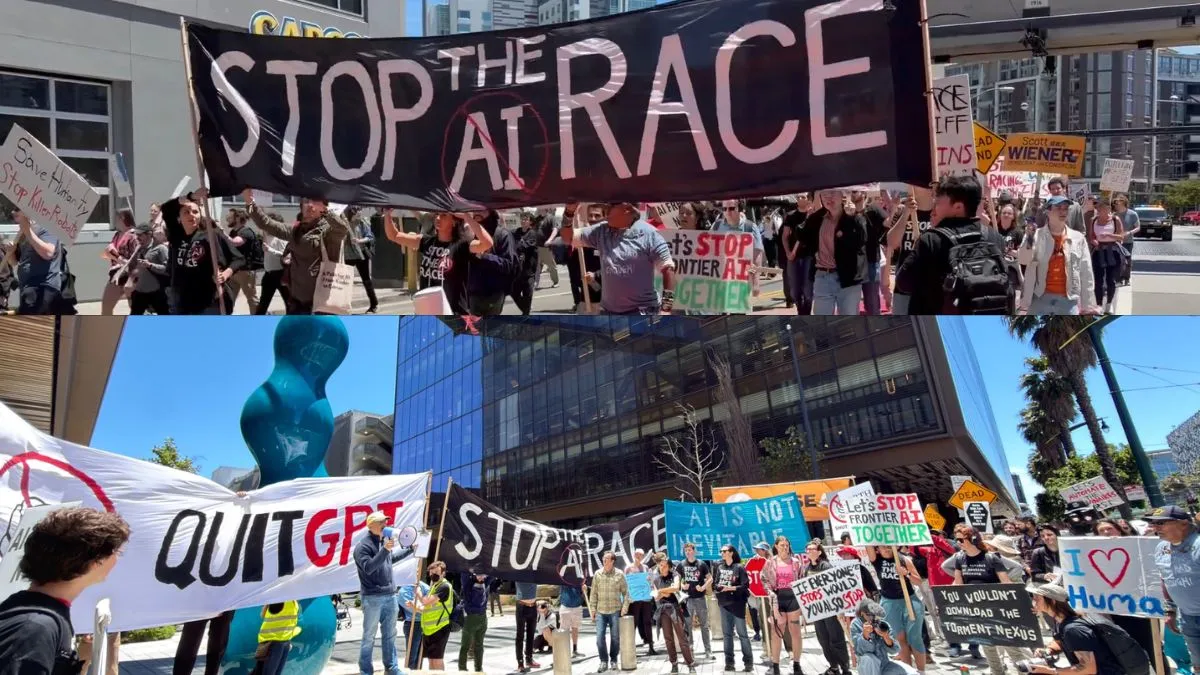
Hundreds of workers, students and tech critics rallied outside the US offices of OpenAI, Anthropic and Google’s AI units over the weekend, accusing major companies of pushing ahead with powerful new systems while jobs are being cut and safeguards lag behind. The demonstrations were part of the “Stop the AI Race” campaign, which is calling on leading labs to slow the rollout of frontier models and to treat AI safety and employment as core responsibilities rather than afterthoughts. Protesters gathered outside OpenAI’s headquarters in San Francisco, then marched to nearby offices of Anthropic and Google‑affiliated AI teams. Organisers said their goal was not to shut down existing tools but to halt the next wave of more capable systems until stronger oversight and worker protections are in place. Signs and speeches drew a direct link between recent layoffs in technology and media and the rapid deployment of AI in areas such as customer service, creative work and software development. Many of those attending were students, engineers and people already working in the tech sector. Some said they feared that companies were using AI as a justification to cut staff and consolidate power, while presenting automation as an inevitable step forward. Others highlighted the lack of clear consent and compensation for artists, writers and other creators whose work has been used to train large models. The protests also focused on broader social costs. Campaigners pointed to the heavy energy and infrastructure demands of large data centres, warning that communities may face higher environmental and grid pressures while the economic benefits flow mainly to a small number of firms and investors. Speakers argued that any serious discussion about AI must include who bears those costs and who gets a voice in decisions about new deployments. “Stop the AI Race” is asking the biggest AI labs to commit to a coordinated pause in training more powerful systems if their main competitors agree to do the same. Supporters say this is the only realistic way to avoid a “race to the bottom” on safety, since no single company wants to slow down while others press ahead. Critics of the proposal counter that a pause could hold back useful advances in medicine, education and productivity, and might entrench the largest players if new rules make it harder for smaller rivals to innovate. For now, none of the targeted companies has publicly accepted the campaign’s demands. Even so, the protests underline how public debate on AI is widening beyond the technical and policy elite. The argument is no longer only about what these systems can do, but about who sets the pace of development, who benefits from the gains and who carries the risks when new technology is deployed at high speed. Photos: Michaël Trazzi / X