Balkan Governments Are Entering the AI Era, But Not at the Same Speed
By Suad Seferi ·
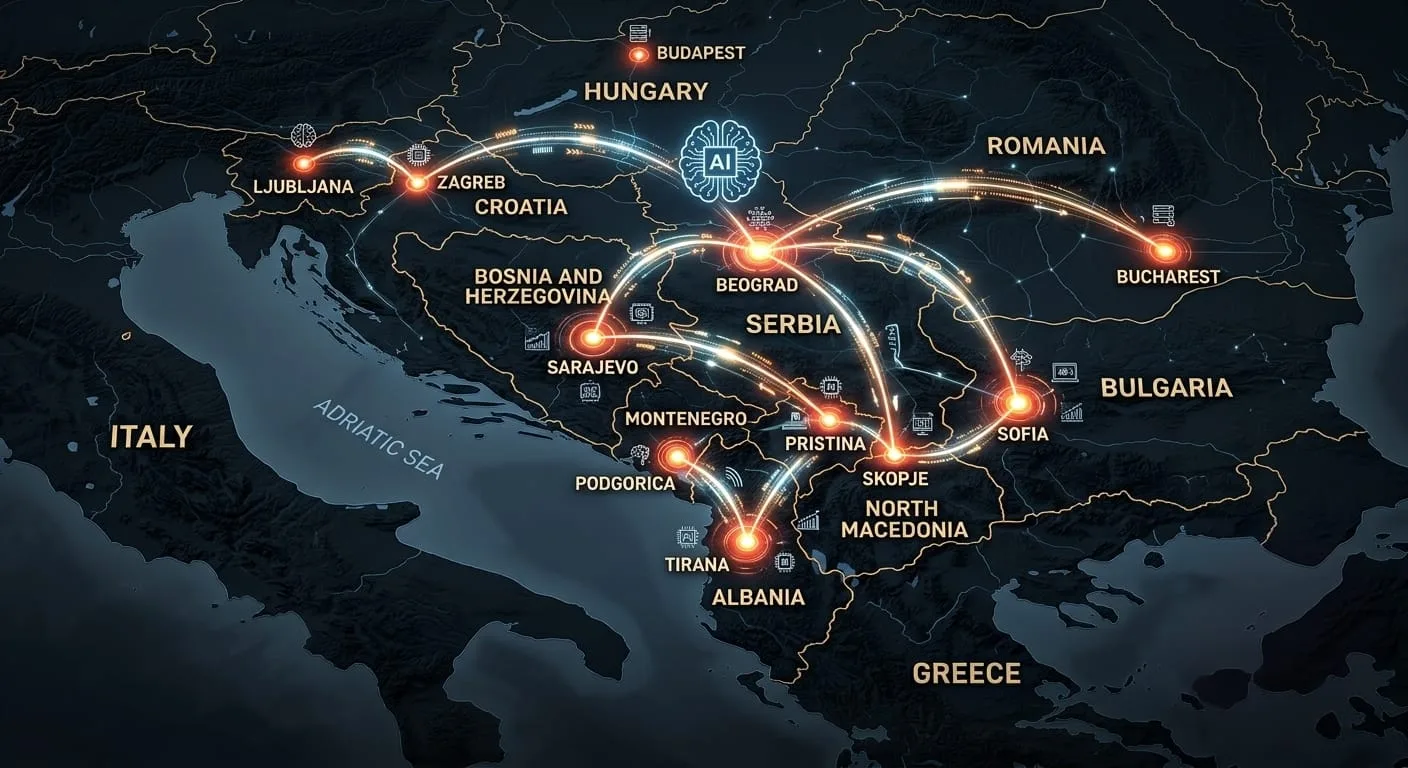
SKOPJE — Artificial intelligence is beginning to move from policy documents into government systems across the Balkans, but the region is not moving in one direction or at one speed. Serbia is building on a national AI strategy and state-backed infrastructure. Albania has gone for a more symbolic and controversial model by giving an AI system a cabinet-level role. Montenegro is preparing a national AI strategy for 2026–2030. North Macedonia is placing AI inside its broader digital transformation agenda and aligning itself with European governance standards. Together, these developments show that AI is no longer only a private-sector or academic issue in the region. It is becoming a public-sector question: how governments deliver services, manage data, fight corruption, regulate technology and maintain citizens’ trust. Serbian Government Serbia remains the most advanced case in the Western Balkans. The country adopted its Artificial Intelligence Development Strategy for 2025–2030, building on an earlier national strategy that started in 2020. The government says the strategy will support AI development across sectors including healthcare, energy, public administration and agriculture. Serbia has also invested in a National AI Platform, located at the State Data Center in Kragujevac, which has become one of the country’s main AI infrastructure projects. Albania has taken a very different path. In 2025, the government presented Diella, an AI-powered virtual assistant on the e-Albania platform, as a cabinet-level “Minister of State for Artificial Intelligence.” According to the Albanian government, Diella had already handled hundreds of thousands of interactions and was connected to digital public services before being given the new role. The move attracted international attention because it placed AI directly inside the political symbolism of government. Albanian Government But Albania’s approach has also raised questions. Reports from international media noted that Diella was linked to public procurement and anti-corruption goals, while critics questioned the legal status, accountability and practical oversight of an AI “minister.” The controversy shows one of the central tensions of AI in government: technology can make public administration faster and more transparent, but it can also create new uncertainty if institutions do not clearly define who is responsible for decisions. Montenegro is moving more slowly, but in a more conventional policy direction. Work has started on the country’s Artificial Intelligence Strategy for 2026–2030, supported by national institutions and international partners. The strategy is expected to connect AI with digital transformation, innovation, public services and priority sectors such as healthcare. For smaller administrations, this strategy-first approach may prove more realistic than high-profile AI projects. Before AI can be deployed responsibly in public services, governments need rules on data protection, procurement, human oversight, cybersecurity and institutional accountability. Without those foundations, chatbot pilots and AI assistants can easily become political announcements rather than durable public-sector reforms. Macedonian Government North Macedonia is still at an earlier stage. The country has not introduced a dedicated AI law, but its SMART/MK 2030 digital strategy places artificial intelligence among the technologies expected to shape digital transformation. North Macedonia has also signed the Council of Europe’s Framework Convention on Artificial Intelligence, Human Rights, Democracy and the Rule of Law, which connects AI governance with democratic safeguards and human rights standards. That makes the next phase important. For North Macedonia, the challenge is not simply whether institutions will use AI. Many already do, informally, through tools used for drafting, translation, research and document analysis. The real question is whether the state can move from informal use to governed use. Across the region, the same pattern is emerging. Governments are interested in AI because it promises faster services, lower administrative costs, better analysis and more efficient communication with citizens. But the risks are also becoming clearer. AI systems can produce wrong answers, expose sensitive data, reinforce bias or make public decisions harder to explain. This matters especially in the public sector, where mistakes affect citizens directly. A private company can experiment with AI and absorb reputational damage if something goes wrong. A government institution has a higher duty: it must protect rights, follow the law and maintain public trust. That is why the next stage of AI adoption in the Balkans will not be judged only by the number of tools launched. It will be judged by whether governments can create the conditions for responsible use. Serbia’s advantage is infrastructure and continuity. Albania’s advantage is visibility and boldness. Montenegro’s advantage may be a more careful strategy process. North Macedonia’s opportunity is to prepare early, before AI systems become deeply embedded in public administration without clear rules. The region is entering the AI government era, but the race is not only technological. It is institutional. The countries that move fastest will not necessarily be the ones that announce the most ambitious AI projects. They will be the ones that build practical governance: trained public employees, clear procurement standards, strong data protection, transparent systems and human accountability. For the Western Balkans, that may become the real test. AI can help modernize public administration, but only if governments treat it as more than another digital tool. It is now becoming part of how the state works.