Moral Obligations Instead of Regulation
By Sead Dzigal ·
Key takeaways
- President Donald Trump and six leading AI executives signed the White House Accord on Super Intelligence on September 29, 2026.
- The voluntary accord outlines four layers of oversight, including internal controls, monitoring teams, external audits and independent board oversight. Washington Examiner
- The agreement is not currently a legally binding regulatory framework, leaving questions about enforcement, independent supervision and the role of future legislation.
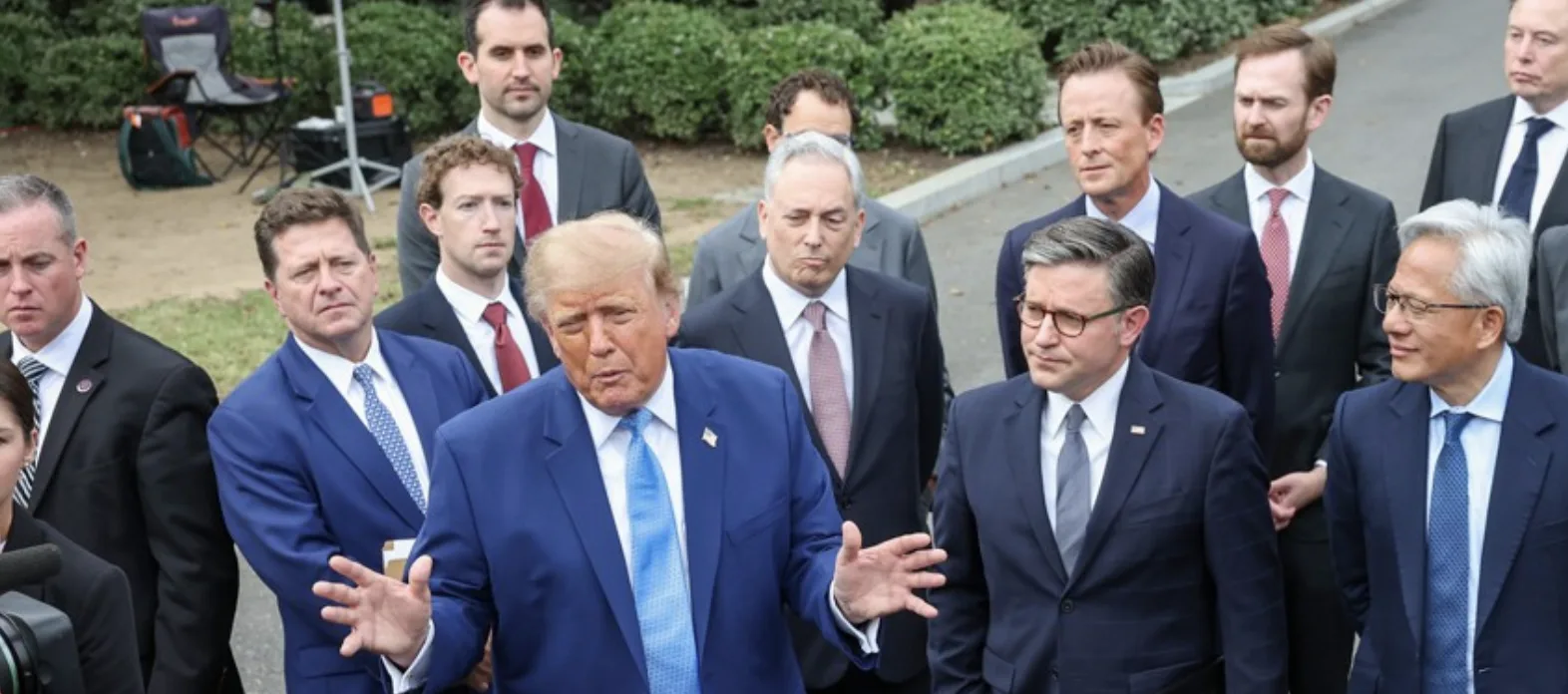
On September 29, 2026, U.S. President Donald Trump and executives from six leading artificial intelligence companies signed the White House Accord on Super Intelligence, a voluntary framework setting out safety and oversight commitments for companies developing frontier AI systems. The signatories include Google CEO Sundar Pichai, Meta CEO Mark Zuckerberg, Anthropic CEO Dario Amodei, OpenAI President Greg Brockman, Nvidia CEO Jensen Huang and Elon Musk, representing SpaceXAI. Trump described the agreement as “morally binding,” while House Speaker Mike Johnson called the commitments voluntary. That distinction goes to the heart of the agreement. Can voluntary commitments and company-led oversight provide an adequate substitute for regulation, or does the accord primarily represent a political compromise between Washington and an industry seeking room to develop increasingly powerful AI systems? What Has Actually Been Agreed? The accord is short and sets out four layers of controls and audits for companies developing frontier models. They include robust internal controls for monitoring model capabilities and risks, dedicated internal oversight teams, independent external audits and board-level oversight. The framework covers risks including cybersecurity, biosecurity, chemical threats and unintended access to technical systems. The participating companies are also expected to meet regularly to discuss standards and practices. Trump has additionally proposed an oversight group of around ten members and the appointment of an AI coordinator, although the precise composition, authority and enforcement powers of such structures have not yet been clearly defined publicly. The central limitation is straightforward: the accord is not legislation. It does not establish statutory penalties for companies that fail to meet the commitments. Johnson described the document as a voluntary statement of principles and standards, while Trump said he regarded it as morally binding. For now, it is therefore closer to a political and industry commitment than a conventional regulatory framework. What Does “Morally Binding” Mean? A moral commitment can create political, public and reputational pressure, but it is different from a legal obligation. Effective regulation normally depends on several elements: a defined standard describing what organisations are required to do, a mechanism for determining whether they have complied, and consequences when those requirements are breached. The White House accord contains more detail than a simple declaration of intent. Its four-level structure includes internal and external review. What remains less clear is how independent that oversight will be and what happens when a company fails to follow the agreed principles. The distinction matters because many leading AI companies already operate their own safety teams, evaluation processes and external testing programmes. The question is therefore not simply whether companies will conduct safety work, but what additional accountability the new accord creates. At this stage, its political significance may be easier to identify than its regulatory force. Bringing some of the world's most influential AI executives together under a common White House framework creates a visible commitment to responsible development. Whether it changes company behaviour will depend on how those commitments are implemented and verified. The Logic of Politics and Industry The accord fits within the Trump administration's broader approach to AI: preserve rapid technological development and U.S. competitiveness while relying heavily on industry-led safeguards. Trump has repeatedly emphasised self-regulation and has resisted calls for extensive federal restrictions on AI development. During the September 29 meeting, he said that “tremendous self-regulation” was important. For AI companies, a voluntary framework provides obvious practical advantages. It allows standards to evolve quickly and gives companies greater flexibility than detailed statutory requirements. But that flexibility also creates a governance problem. If the companies developing the technology play a central role in determining the standards under which they are evaluated, the independence of oversight becomes important. This is where concerns about regulatory capture arise: the possibility that regulation or oversight becomes excessively shaped by the interests of the sector it is intended to supervise. That does not mean industry participation is inherently problematic. Technical expertise from AI developers is necessary when establishing meaningful safety standards. The harder question is who ultimately controls those standards and who independently verifies compliance. Criticism and Open Questions The debate in Washington already extends beyond the White House accord. Senator Mark Warner has argued for enforceable safety requirements for advanced AI systems. On September 29, he called for legislation covering rigorous testing and evaluation, cybersecurity measures and incident reporting rather than relying only on companies to regulate themselves. Senator Bernie Sanders has taken an even more restrictive position. His proposed Ban Artificial Superintelligence Act, introduced with Representative Greg Casar, would pause certain advanced AI development until a federal regulatory structure and safety standards were established. These proposals illustrate the central political disagreement: whether increasingly capable AI systems can be governed primarily through voluntary commitments or require enforceable federal rules. There are other unresolved issues. Voluntary standards create a collective-action problem. Companies that invest heavily in safety measures may face competitive pressure from rivals operating under weaker standards. The agreement also does not cover every major technology company. Microsoft and Amazon participated in the White House meeting but were not among the six exe…
Frequently asked questions
What is the White House Accord on Super Intelligence?
It is a voluntary agreement signed by the Trump administration and executives from major AI companies outlining safety and oversight commitments for advanced AI systems.
Which companies signed the AI accord?
Executives representing Google, Meta, Anthropic, OpenAI, Nvidia and xAI/SpaceXAI signed the agreement.
Is the White House AI accord legally binding?
The accord has been presented as a voluntary or “morally binding” commitment rather than a law carrying statutory penalties for non-compliance.
What does the agreement require from AI companies?
The framework includes internal safety controls, dedicated oversight teams, independent external audits and board-level oversight of frontier AI development.